2 May 2026· Laatst bijgewerkt May 2026
De exacte muziektijdlijn voor elke fase van je bruiloftsdag, van ceremonie tot laatste dans. Plus de energiecurve die de dansvloer vol houdt.
De zes muziekmomenten van een bruiloftsdag
De meeste stellen plannen muziek voor "de receptie" alsof het een blok is. Dat is het niet. Een typische bruiloftsdag heeft zes onderscheiden muziekmomenten, elk met een eigen taak:
1. **Preludium:** voor de ceremonie begint, terwijl gasten aankomen
2. **Ceremonie:** processie, ceremonie, uittocht
3. **Welkomstborrel en cocktail hour:** na de ceremonie, voor het diner
4. **Diner:** achtergrondmuziek tijdens het zittende diner
5. **Receptie en opening dansvloer:** openingsdans, dan gaat de vloer open
6. **Late avond of afterparty:** de afsluiter
Plan ze elk apart en de hele dag stroomt.
Moment 1: Preludium (15 tot 30 minuten voor de ceremonie)
Het preludium zet de emotionele toon. Je gasten arriveren, vinden hun plek, orienteren zich. De muziek moet aanwezig zijn maar zacht, instrumentaal en warm.
Voor een verfijnde bruiloft is een akoestische act als **Dupa Trio** hier ideaal: opnieuw uitgevoerde jazzstandards, zachte arrangementen op piano, of instrumentale versies van popnummers die je gasten onbewust herkennen. Voor een moderne ceremonie werkt ambient piano of een strijkkwartet even goed.
Volumerichtlijn: hoorbaar genoeg maar stil genoeg voor gesprek. Ongeveer 60 tot 65 dB op de achterste rij.
Moment 2: Ceremonie (20 tot 45 minuten)
De ceremonie heeft drie muziekcues:
Acts als **Dupa Trio** zijn gespecialiseerd in deze overgang. De processie kan een langzame pianoversie van een betekenisvol nummer zijn. De uittocht is de lift. Het publiek moet glimlachen wanneer ze teruglopen.
Als de ceremonie religieus is of een specifieke traditie volgt, zijn de muziekkeuzes deels vast. Bespreek het met de ceremoniemeester voor het bandgesprek.
Moment 3: Welkomstborrel en cocktail hour (60 tot 90 minuten)
Dit is wanneer de energie begint op te bouwen, maar langzaam. Gasten mengen, eten hapjes, drinken. De muziek moet aanwezig, warm en ritmisch zijn, maar niet agressief.
Dit is het perfecte venster voor een jazztrio, akoestisch duo of kleinere live act. **Dupa Trio** is onze meest geboekte optie voor dit moment omdat het format schaalt van achtergrond naar voorgrond afhankelijk van de zaal. Spreekt de duo-route je aan, dan behandelt onze gids over een akoestisch duo boeken voor je bruiloft wat het kost en waar het past.
Volumerichtlijn: 70 tot 75 dB, aanwezig genoeg om levendig te voelen maar makkelijk overheen te praten.
Als je een DJ hebt ingehuurd als **Savoy** of **Demi Elisa** als onderdeel van een hybride boeking, is dit het moment waarop de DJ het kan overnemen met een zachte, samengestelde cocktailset. Beide benaderingen werken.
Moment 4: Diner (90 tot 150 minuten)
Diner is het langste muziekmoment van de dag en het moment dat de meeste stellen het minst zorgvuldig plannen.
De juiste aanpak: doorlopende, ingetogen achtergrondmuziek tijdens de hele maaltijd. Het volume moet onder gespreksniveau blijven. De energie moet pas opbouwen als het diner eindigt.
Een live act als Dupa Trio kan het hele diner dragen met een doorlopende set van instrumentale en licht-gezongen arrangementen. Een DJ kan hetzelfde met een samengestelde playlist op achtergrondvolume. Vermijd:
De overgang van diner naar receptie is een van de belangrijkste momenten om te plannen. Vaak wordt het gemarkeerd door een bewuste energieverschuiving: lichtveranderingen, een MC-aankondiging, of de band die overschakelt van instrumentaal naar vocaal.
Moment 5: Receptie en opening dansvloer (45 tot 90 minuten)
Dit is het moment waar de meeste stellen aan denken als ze aan bruiloftsmuziek denken. Het is het blok met de hoogste inzet van de dag.
De structuur ziet er meestal zo uit:
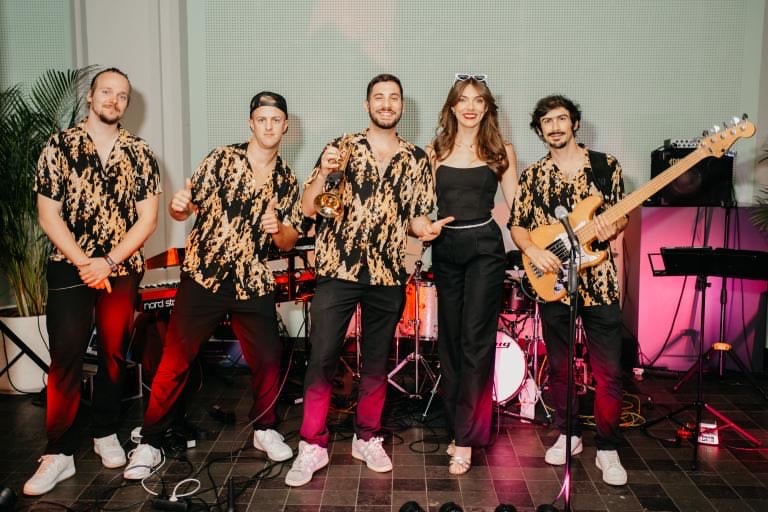
De juiste muziek hier hangt af van de band die je hebt geboekt. Voor **Benga Band** zijn de openingsnummers popklassiekers met blazerenergie. Voor **Drumpet Disco** opent de vloer met klassieke disco die elke generatie de dansvloer op trekt.
Openingsnummers die we consistent zien werken bij honderden bruiloften:
Als de band de vloer in de eerste 20 minuten niet kan opentrekken, wordt de rest van de avond moeilijker. Brief de band welke nummers de leiding nemen.
Moment 6: Late avond of afterparty (60 tot 180 minuten)
Zodra de dansvloer open en vol is, is de energie aan jou om te managen. De meest voorkomende structuur voor een sterke avond:
Het hybride model bestaat precies voor dit moment. Een liveband brengt de onvervangbare energie van echte performance gedurende het tweeuursblok in primetime. Een DJ houdt de dansvloer doorgaand zonder de muzikanten uit te putten en zonder de ongemakkelijke energie-onderbreking van "de band is nu gestopt, alstublieft uiteen". Twijfel je nog tussen de twee formats, dan zet onze vergelijking van band en DJ voor de bruiloft de afwegingen op een rij, en er zijn vijf dingen die je wilt weten voordat je een DJ boekt. Voor de Amsterdamse invulling van dat late blok staat de uitleg op een DJ voor je bruiloft in Amsterdam.
Voor bruiloften met meer dan 150 gasten of avonden die na middernacht doorlopen, raden we deze hybride structuur vrijwel altijd aan. **Benga Band plus Savoy** of **Drumpet Disco plus Demi Elisa** zijn onze meest geboekte combinaties.
De volledige tijdlijn in een overzicht
| Tijd | Moment | Muziek | Volume | Sfeer |
|---|---|---|---|---|
| Pre-ceremonie | Preludium | Instrumentaal, zacht | 60 tot 65 dB | Warm, welkom |
| Ceremonie | Processie, geloften, uittocht | Samengesteld, vooral live of akoestisch | Wisselend | Emotioneel |
| Cocktail hour | Welkomstborrel | Jazz, akoestisch, lichte DJ | 70 tot 75 dB | Aanwezig, conversationeel |
| Diner | Zittend diner | Achtergrond instrumentaal | Onder gespreksniveau | Rustig, zachte opbouw |
| Receptie | Openingsdans, vloer open | Liveband, dansvloernummers | 85 tot 90 dB | Hoge energie-opbouw |
| Late avond | Afterparty | Liveband piek dan DJ | 90 tot 95 dB | Volle dansvloer |
Hoe de band te briefen op de tijdlijn
Zodra je een conceptdraaiboek hebt, brief je de band 30 dagen voor de bruiloft met drie documenten:
1. **Het volledige schema:** elke cue, elke overgang, elke gesproken aankondiging
2. **De Spotify-wensenlijst:** nummers die je erin wilt
3. **De no-play-lijst:** nummers die in geen geval gedraaid mogen worden
Een goede band beoordeelt dit en biedt aanpassingen. Ze weten waar de energiecurve gaten of knelpunten heeft en zullen oplossingen voorstellen waar jij niet aan had gedacht.
Wat te doen als de tijdlijn uitloopt
Dat gebeurt. Ceremonies starten te laat. Het diner loopt uit. De speeches duren een kwartier langer.
De juiste aanpak is de band te briefen wat te doen als het schema uitloopt:
Professionele bands handelen dit af zonder dat het in het moment gezegd hoeft te worden. Zorg dat je contract flexibiliteit op starttijden binnen redelijke grenzen bevat, meestal 30 tot 60 minuten buffer.
Een praktische korte lijst om je tijdlijn omheen te bouwen
Voor de meeste Nederlandse en Belgische bruiloften is dit de structuur die we aanraden:
Luister ze allemaal en bekijk livevideo op onze artiestenpagina.
Veelgestelde vragen
Hoe lang moet de ceremoniemuziek duren?
Ongeveer 20 tot 45 minuten totaal, inclusief 5 tot 10 minuten preludium voor de bruid binnenkomt.
Moeten we livemuziek of een DJ hebben tijdens het diner?
Beide werken. Live akoestische muziek (jazztrio, akoestisch duo) voegt warmte toe. Een samengestelde DJ-playlist op laag volume werkt even goed. Vermijd luide muziek tijdens het diner.
Wanneer moet de openingsdans plaatsvinden?
Meestal direct na het einde van het diner en de opening van de dansvloer, rond 21.00 tot 21.30 uur. Sommige stellen doen het liever later, rond 22.30 uur, om zeker te zijn dat de vloer al vol is.
Hoe lang moet het openingsdanslied zijn?
Het volledige nummer, meestal 3 tot 4 minuten. Sommige stellen kiezen voor een verkort arrangement, vooral als het nummer langer is dan 5 minuten. Bespreek met de band.
Kan de band ons openingsdanslied leren?
Ja, meestal met minstens drie maanden van tevoren. Complexere arrangementen vragen zes maanden.
Hoe laat moet de dansvloer sluiten?
Hangt af van de spertijd van de locatie. De meeste Nederlandse en Belgische locaties eindigen muziek om middernacht of 01.00 uur. Sommige staan tot 02.00 uur of later toe.
Moeten we een aparte band huren voor de afterparty?
Voor de meeste bruiloften niet. Een enkele hybride boeking (band plus DJ) dekt de volledige avond. Voor bruiloften met een afterparty op een aparte locatie is een aparte DJ-boeking gangbaar.
Welke muziek moet er spelen tijdens de openingsdans voor ouders?
Langzamer, sentimenteel, vaak een nummer met persoonlijke betekenis voor de ouder. De band kan opties voorstellen op basis van je muzieksmaak.
Hoe lang is het typische receptieblok?
Drie tot vijf uur, inclusief diner, dansen en geplande activiteiten. Het livemuziekdeel is meestal twee tot drie uur van het totaal.
Wat is de meest voorkomende tijdlijnfout?
De band te vroeg boeken voor de opening van de dansvloer. De vloer heeft tijd nodig om te vullen. Als de band start voordat de gasten klaar zijn, piekt de energie voordat de zaal vol is en herstelt nooit helemaal.
Volgende stap
Vertel ons je bruiloftsdatum, locatie en ruwe tijdlijn. We bouwen er een muziekplan omheen, met de juiste acts voor elk moment.
Vraag een persoonlijk muziekplan aan of bekijk de volledige Lupa-roster.
De Lupa-acts die we hiervoor aanraden
Elk van onze acts is samengesteld voor een specifiek soort zaal. Drie van de meest geboekte bij Lupa voor de onderwerpen op deze pagina:
Bekijk de volledige artiestenroster voor de rest van de line-up.
Een event aan het plannen?
14 persoonlijk geselecteerde acts, bands, dj's en ensembles, klaar om jouw event onvergetelijk te maken.