6 October 2026· Last updated October 2026
Background music vs live band for a conference, and DJ vs live band for a trade show: which works for registration, breaks, networking and the closing drinks, with real prices.
Background music vs live band for a conference: which should you book?
Book background music for the conference day and a live band for the evening. That is the short version, and it holds for almost every conference we work on in Amsterdam and across the Netherlands. The day is built around conversation: registration, coffee breaks, lunch, networking. The evening is built around energy. One act rarely does both jobs well.
The real question is not "background music or live band" but "which moment am I booking for". A conference has four or five distinct moments, and each one has a different right answer. Get that split right and the budget usually goes further than planners expect.
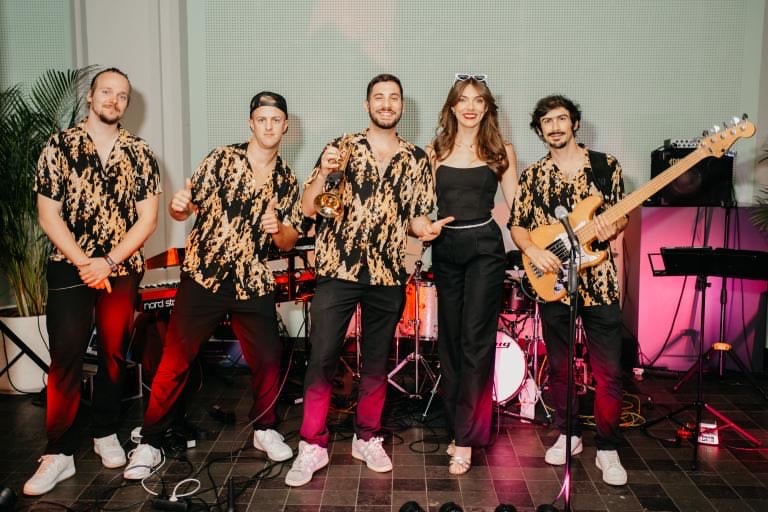
I am Noam Bargil, founder of Lupa Entertainment and bandleader of Benga Band. We book music for corporate events for clients including Heineken, Microsoft, Salesforce and Booking.com, at venues such as RAI Amsterdam and Beurs van Berlage. The formats we offer for the day itself are on our background music for conferences and trade shows page.
What is the difference between background music and a live band at a conference?
Background music supports conversation; a live band replaces it. Background music, whether live or from a DJ, sits at roughly the level of a normal conversation, around 60 decibels, so two people can talk at arm's length without raising their voices. A live band is built to be listened to and danced to, which means drums, amplification and a volume that ends conversations.
That is why "live" and "background" are not opposites. A jazz trio or an acoustic duo is live music played as background. A party band like Benga Band is live music played as the main event. Planners who mix up those two categories end up with a band that is too loud for the coffee break or a playlist that is too thin for the closing drinks.
Which works best for each moment of a conference day?
This is the split we recommend most. Prices are Lupa starting prices.
| Moment | Best choice | Why | Lupa from |
|---|---|---|---|
| Registration and arrival | Jazz trio or acoustic duo | Calms the queue, stops cleanly for announcements | €900 duo, €1,600 trio |
| Coffee breaks and lunch | Acoustic duo or low DJ set | Fills silence in a big foyer without competing | €1,000 DJ, €900 duo |
| Networking session | Jazz trio | Gives the room warmth while people work the room | €1,600 |
| Closing drinks | DJ with live saxophone | Lifts the energy, still allows conversation | DJ from €1,000, sax quoted on top |
| Evening dinner or party | Live band | People have stopped working and want a show | €3,000 four piece |
For the networking hours we often route Dupa Trio (trumpet, guitar, bass and vocals) or Fourtunes (piano, vocals and bass), because both play recognisable material quietly enough to talk over. For the closing drinks, Tom Jaxx or Golden Sax over a DJ set is the format that turns a tired room around in about fifteen minutes.
DJ vs live band for a trade show: which works better?
For the show floor, neither is ideal on its own; a small live act beats both. A DJ playing all day becomes wallpaper after an hour, and a full live band is too loud for the aisles and is usually blocked by the organiser's sound rules. On a stand, a soloist or a saxophonist over a quiet DJ bed works best. Our guide to trade show booth entertainment goes deeper on stand size, power and footfall timing.
After the doors close, the answer flips. For the exhibitor party or the closing reception, a DJ is the flexible, lower cost option and a live band is the memorable one. A corporate event DJ covers a long night and adapts to the crowd; a live band gives the night a peak people talk about on the train home. If the budget allows only one, a DJ with a live saxophonist sits between the two.
How much does conference music cost in the Netherlands?
Indicative market ranges for the Netherlands and Belgium; Lupa quotes every event individually:
- Acoustic duo: €600 to €1,200
- Jazz trio: €1,400 to €2,400
- DJ plus saxophonist: €1,200 to €2,500
- Four piece band: €1,800 to €3,200
- Five to six piece band: €2,500 to €6,000
At Lupa a soloist starts from €600, an acoustic duo from €900, a DJ from €1,000, a DJ with sound and light from €1,850, a jazz trio from €1,600 and a four piece band from €3,000, sound and light from €850 extra. A full conference day with a trio in the morning and a DJ with saxophone for the closing drinks usually lands well below the cost of a single evening band. Our corporate event music cost guide breaks down what is included.
What do planners get wrong when choosing?
Three mistakes come up again and again:
- Booking the evening act for the daytime. A party band at registration is too loud, and paying a band to sit idle between moments wastes the budget.
- Treating a playlist as free. Someone has to run it, adjust volume and fade it for every announcement. A good DJ or duo does that without being asked.
- Forgetting the venue's rules. Conference venues set sound limits and often need music rights covered through organisations such as Buma/Stemra. Ask the venue before you book, not after.
Frequently asked questions
Should I book background music or a live band for my conference?
Background music for the programme day, a live band for the evening. During registration, breaks and networking people need to talk, so a trio, duo or low DJ set works best. Once the formal programme ends, a band gives the event its high point.
How much does background music for a conference cost?
At Lupa an acoustic duo starts from €900, a DJ from €1,000 and a jazz trio from €1,600. Indicative market ranges in the Netherlands run from about €600 for a duo to €2,400 for a jazz trio.
What is the best background music for a corporate conference?
A jazz trio or acoustic duo playing instrumental or lightly sung arrangements of familiar songs. It feels warmer than a playlist, stays at conversation level and stops cleanly when the host takes the microphone.
Is a DJ or a live band better for a trade show party?
A live band if you want the night remembered, a DJ if you need flexibility over a long evening. A DJ with a live saxophonist combines both and is the format we book most for exhibitor parties.
Can a live band play quietly enough for networking?
A jazz or acoustic line up can; a party band cannot. Drums and amplified bass set a volume floor. For networking, book a trio or duo without a full drum kit.
How do I hire conference music in Amsterdam?
Send the date, the venue, the programme and the moments you want covered. We reply within 12 hours with two or three acts per moment and a set schedule that fits the agenda.
How far in advance should I book music for a conference?
Six to ten weeks, and earlier for September to November and December, when the Amsterdam conference and party calendar is full.
Next step
Send us the date, the venue and your programme. We reply within 12 hours with a split that fits each moment of the day, two or three act options and a clear price. If a moment does not need music, we will tell you. Request a proposal or browse the full roster.
Related reading
Start with entertainment for a trade show booth, the stand side of the same decision.
Then jazz trio vs lounge DJ for a cocktail hour, which covers the networking and drinks moment in detail.
And jazz band vs party band: which is right when the evening is part of the plan.
Planning an event?
14 hand-picked acts, bands, DJs and ensembles, ready to make your event memorable.