29 September 2026· Last updated September 2026
How to choose entertainment for a trade show booth, and what background music for registration and arrival should sound like: acts, volume, space, power and real prices.
What background music works for registration and arrival at a trade show?
"We need background music for registration and arrival, what works?" That is close to word for word how most trade show inquiries reach us, and the honest answer is: less than you think, played better than you expect. Registration is a queue. The music has one job, which is to make a ten minute wait feel like three, without drowning out the person at the desk asking for your surname.
What works at the registration desk is an acoustic line up or a jazz trio, instrumental or with very light vocals, starting 30 minutes before doors open. Foyers are hard, glassy rooms that bounce sound around, so three real instruments at conversation level carry better than two speakers on stands turned up to fight the echo. When the host needs to make an announcement, the band drops out on a cue, not after a wave from across the room.
I am Noam Bargil, founder of Lupa Entertainment and bandleader of Benga Band. We book entertainment for corporate events in Amsterdam and across the Netherlands, for clients including Heineken, Microsoft and Booking.com. Everything below comes from what we see work, and fail, on real event floors. The formats we offer for conference and exhibition days sit on our background music for conferences and trade shows page.
How do you choose entertainment for a trade show booth?
Choose entertainment for a trade show booth by working backwards from the conversation. A stand exists to start sales conversations, and every act either helps those conversations or competes with them. Three questions decide it:
- Can two people one metre apart talk at a normal voice while the act plays? Normal conversation sits around 60 decibels. If the act needs more than that to sound good, it is the wrong act for the stand.
- Does it pull people in from the aisle? A live instrument you can see being played stops footfall. A speaker in the corner does not.
- Does it fit the stand? A 3 by 3 metre stand has no room for a trio and a coffee counter. Measure first.
The mistake we see most is booking a DJ to play all day. After four hours your own staff hear the same forty tracks for the third time, the neighbouring stands complain, and the organiser asks you to turn it down. Music on a stand should arrive, do its job and stop.
Which acts work best on a trade show stand?
Small, visual, live acts work best. These are the Lupa acts we route to exhibition and conference days most often.
| Act | Format | Best moment | Stand space needed |
|---|---|---|---|
| Tom Jaxx | Live saxophone with DJ | Footfall peaks, stand drinks | About 2 by 2 metres |
| Golden Sax | DJ plus live saxophone | Late afternoon drinks | About 2 by 2 metres |
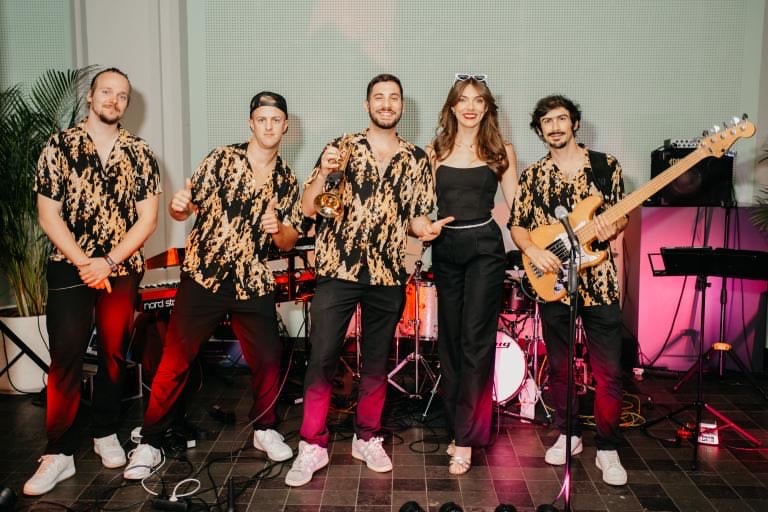
| Dupa Trio | Jazz trio, trumpet, guitar, bass and vocals | Registration, arrival, lunch | About 3 by 2 metres |
| Laura Dooge | Jazz vocals, guitar and bass | Arrival, VIP lounge | About 3 by 2 metres |
| Fourtunes | Piano, vocals and bass | Hospitality area, client dinner | About 3 by 2.5 metres |
| Savoy | DJ, soul and swing into modern pop | Closing drinks, evening reception | About 2 by 1.5 metres |
The live saxophonist is the stand format we recommend most. One musician, a small footprint, and a sound that turns heads in an aisle without filling it. We explain when that format earns its fee in is a DJ with a live saxophonist worth it.
When should the music play during a trade show day?
Play in short sets timed to footfall, not continuously. A trade show day runs eight to ten hours, and the aisles are busy in three waves: the first hour after doors open, the lunch window, and the late afternoon when stands start pouring drinks.
A schedule that works on most exhibition days:
| Time | What happens | Music |
|---|---|---|
| 08:30 to 09:30 | Registration and arrival | Jazz trio or acoustic duo in the foyer, low level |
| 10:00 to 12:00 | Morning sessions, busy aisles | Two 20 minute live sets on the stand |
| 12:30 to 13:30 | Lunch peak | One 30 minute set, the strongest pull of the day |
| 14:00 to 16:00 | Quiet afternoon | Silence or a very low DJ bed |
| 16:00 to 18:00 | Stand drinks | Live saxophone over DJ, volume up one step |
Silence between sets matters. It gives your team room to close the conversations the music started, and it makes the next set feel like an event rather than wallpaper.
What does trade show booth entertainment cost?
Booth entertainment is one of the cheaper line items on a stand budget. Lupa starting prices are a soloist from €600, an acoustic duo from €900, a DJ from €1,000 or €1,850 with sound and light, and a jazz trio from €1,600. A four piece band starts at €3,000, sound and light from €850 extra, but that belongs at the evening reception, not on the stand.
For comparison, these are indicative market ranges for the Netherlands and Belgium; Lupa quotes every event individually.
| Format | Market range |
|---|---|
| Acoustic duo | €600 to €1,200 |
| Jazz trio | €1,400 to €2,400 |
| DJ plus saxophonist | €1,200 to €2,500 |
| Four piece band (evening only) | €1,800 to €3,200 |
Multi day shows are usually priced per day, and a second consecutive day often costs less than the first because travel and setup are already done. Budget for exhibitor passes and parking for the musicians too, which the organiser rarely includes. For the wider picture, see what live music costs for a corporate event.
What practical details do exhibitors forget?
The act is rarely what goes wrong. The exhibitor manual is. Four things to settle at least four weeks before build up:
- Sound rules. Most exhibition halls cap stand audio and forbid sound that spills into the aisles, and the organiser can switch you off mid show. Ask for the rule in writing. Our guide to noise limits and permits for live music in the Netherlands explains how those limits are set.
- Power. Order stand power through the organiser before their deadline. An acoustic setup needs one standard 230 volt socket; a DJ with lights needs more.
- Passes and load in. Musicians need exhibitor badges and a load in slot. Without them your saxophonist waits at the service gate while the lunch peak passes.
- Music rights. Playing recorded or live music in public in the Netherlands involves rights organisations such as Buma/Stemra and Sena. Check whether the venue or organiser licence already covers your stand.
Is live entertainment on a stand better than a playlist?
Yes, when the goal is footfall. A playlist fills silence; a live musician gives people a reason to stop, and a stopped visitor is a conversation your team can start. For a stand that mainly hosts pre booked meetings, a quiet playlist or no music at all is often the right call. We would rather tell you that than sell you an act you do not need.
The same logic applies later in the day. If the show ends with a drinks reception or a gala, that is where a jazz trio for the dinner and a band or DJ for the party earn their place. Our corporate entertainment in Amsterdam page covers the evening formats, and the product launch entertainment guide shows how to frame a reveal on stage.
Frequently asked questions
How much does entertainment for a trade show booth cost?
At Lupa a soloist starts from €600, an acoustic duo from €900, a DJ from €1,000 and a jazz trio from €1,600 per day. Indicative market ranges in the Netherlands run from about €600 for a duo to €2,500 for a DJ with a saxophonist.
How do I hire a musician for my trade show stand in Amsterdam?
Send the show name, dates, stand size and the times you want music. We reply within 12 hours with two or three acts that fit the stand and the hall rules, and we handle passes and load in with the organiser.
Can I book live music for a conference registration and arrival?
Yes. A jazz trio or acoustic duo in the foyer, starting 30 minutes before doors, is the format we book most for registration. It keeps the queue relaxed and stops cleanly for announcements.
What is the best entertainment for a trade show booth?
A live saxophonist over a low DJ bed, for most stands. It needs about 2 by 2 metres, draws people in from the aisle, and stays quiet enough for sales conversations to continue at the table.
Can a small stand have live music?
Yes, if the act is one musician. A soloist needs roughly 1.5 by 1.5 metres and a single power socket. On a 3 by 3 metre stand, skip the trio and book a saxophonist or a guitarist singer for short sets.
Should I hire a DJ or live music for a trade show stand?
Live music, for footfall. A DJ alone becomes background after an hour, while a visible musician keeps stopping people. A DJ works well for the closing drinks, ideally with a live saxophonist on top.
How loud can music be on an exhibition stand?
That is set by the organiser, not by you. Most exhibitor manuals limit stand audio so it does not spill into the aisles. As a rule of thumb, two people one metre apart should be able to talk at a normal voice.
How far in advance should I book trade show entertainment?
Six to eight weeks, and earlier for September to November when the Amsterdam show calendar is full. That also leaves time to order power and passes before the organiser's deadlines.
Next step
Send us the show, the dates, your stand size and the hours you want covered. We reply within 12 hours with two or three acts that fit that stand and those hall rules, including a set schedule timed to the footfall peaks. If your stand does not need music, we will say so. Request a proposal or browse the full roster.
Related reading
Start with whether a DJ with a live saxophonist is worth it, the stand format we recommend most.
Then jazz trio vs lounge DJ for a cocktail hour, which is the same decision you face for arrival and registration.
And what live music costs for a corporate event when the trade show ends with an evening reception.
Planning an event?
14 hand-picked acts, bands, DJs and ensembles, ready to make your event memorable.