22 September 2026· Last updated September 2026
The five venue facts that decide whether a band sounds good and plays past midnight: the decibel limit, the end time, power at the stage, the load-in, and what "sound system included" really covers.
How do you choose an event venue in Amsterdam that works for live music?
Short answer: choose an Amsterdam event venue on five facts rather than on photographs. The decibel limit written into the venue's permit, the hour the music has to stop, the power available where the stage will stand, the load-in route from the street, and whether the house sound system can genuinely carry a dance floor. A four-piece band from our roster arrives with its own sound and light from €3,000, so the house system matters far less for a band than it does for a DJ, where a working PA is the difference between €850 and €1,500. Get the noise limit and the end time in writing before you sign.
I have been the bandleader of Benga Band since 2018, and Lupa has produced more than three hundred events across the Netherlands. We have played rooms that looked ordinary in photographs and sounded superb, and rooms that photograph beautifully and fight the music all night. The difference is never the styling. It is five practical facts, and every one of them is knowable before you sign a contract.
What actually decides whether live music works in a venue?
The noise limit
Almost every Amsterdam venue operates under a permit with a decibel ceiling, and many enforce it with a limiter wired into the house power. If the limiter trips, the stage goes silent mid-song. A drummer alone, with no amplification at all, sits around 100 dB at a few metres. That single number rules out more venues for a full band than price ever does.
The end time
The hour the music stops is set by the venue's permit, not by your enthusiasm. In practice most Amsterdam venues in or near residential streets stop amplified music at 23:00, while purpose built event halls and some club style locations run to 01:00 or later. This changes your entire run of show, so settle it before the deposit.
Power at the stage position
Not power in the building. Power within cable reach of where the band will actually stand. A four to six piece band with full production needs two separate 16 amp groups. Sharing one group with the caterer's ovens is the most common cause of a blown fuse at 22:00.
The load-in
How far is the street from the stage, are there stairs, is there a lift, and can a van stop outside without a fine. A band carries roughly 400 kilos of backline, PA and lighting. Twenty metres of flat floor is half an hour. Two flights of canal house stairs is two hours and a heavier quote.
Ceiling height and hard surfaces
A low ceiling over a hard floor with glass walls turns a live band into a wash of reverb, and the only fix on the night is to turn down, which kills the dance floor. High ceilings, soft furnishings and people all absorb sound. A room that echoes when empty at a site visit will echo at the party too, just less.
How much space and power does each act size need?
These are the figures we actually put on our technical riders, so you can check a venue against them before either side commits.
If a venue cannot give you these numbers in writing, that is itself an answer. Venues that host live music regularly have a technical sheet ready within the hour.
What does "sound system included" actually mean?
It usually means a background music system, which is a different product from a dance floor system. A ceiling speaker setup built for dinner playlists will not carry a band or fill a floor at 23:00, and pushing it produces distortion rather than volume.
Ask for the brand and model of the house system in writing, plus the number of speakers and whether there is a subwoofer. A system without a sub cannot reproduce a kick drum or a bassline, which is most of what makes people dance.
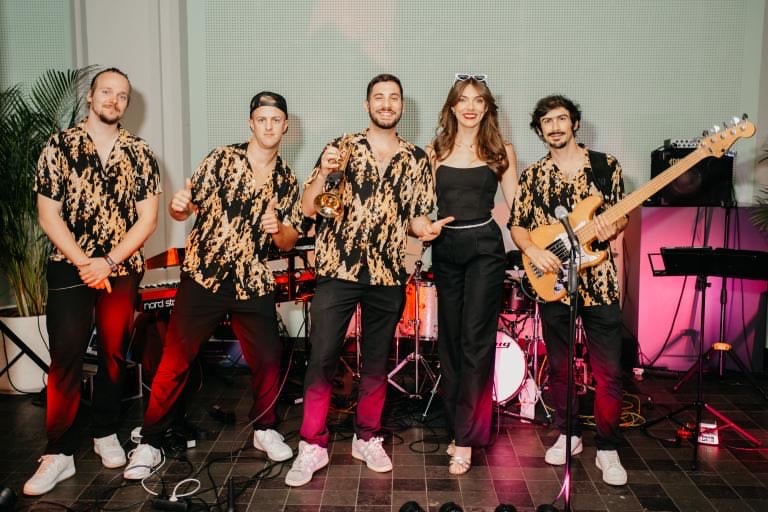
This matters most for DJs. A DJ at our floor price of €850 assumes the venue owns a working PA and dance floor lighting. €1,500 is the DJ who brings the full system. For bands the question mostly disappears, because our four piece and larger line ups include sound and light in the fee. Benga Band turns up with its own production, and as the band's own description puts it, you do not need to organise a single cable.
Which type of Amsterdam venue suits which event?
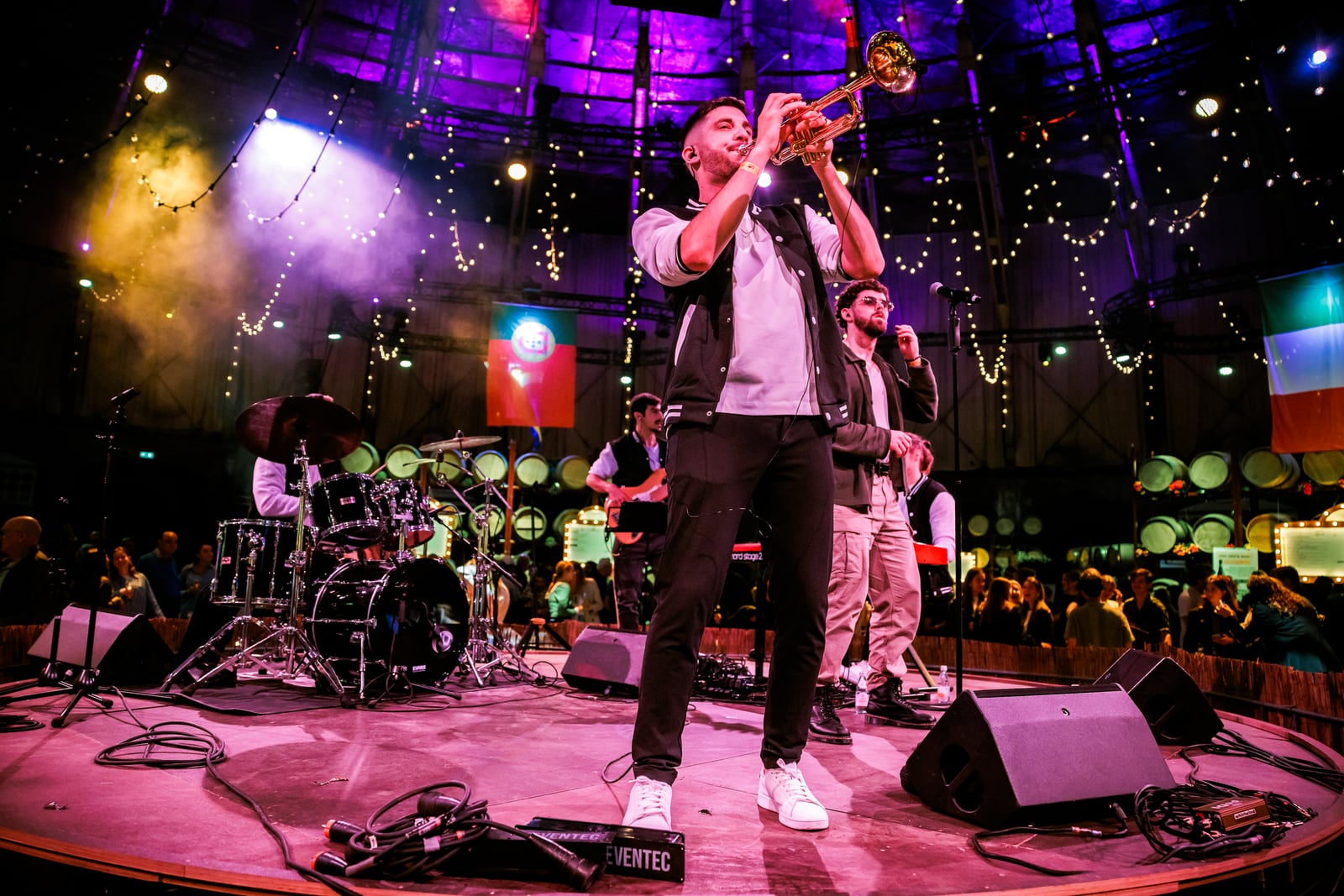
We have played most of these categories in Amsterdam. Industrial rooms like Westergasfabriek, the Gashouder, Thuishaven and Kantine25 handle volume and give a band room to work. Hotel ballrooms at Anantara Krasnapolsky, the Pulitzer and Park Inn by Radisson Amsterdam are controlled and reliable, and usually stricter on end times. Dupa Trio played the Rijksmuseum for Microsoft, where the brief was presence without volume, and the Hortus Botanicus is the kind of garden setting where an acoustic set beats a PA every time.
The A'DAM Toren is the case that proves the point about height and hard surfaces: a spectacular room where the music has to be mixed for the space rather than against it.
Does the venue change your music budget?
Yes, and mostly in one direction. A venue that already owns a real PA and dance floor lighting can take a DJ booking from €1,500 down to €850. A venue with stairs, a distant load-in or a 22:00 sound stop adds crew time, and sometimes an hour of standby, to any live booking.
Our own starting prices are fixed and public: soloist from €600, acoustic duo from €900, jazz trio from €1,400, four piece band from €3,000 including sound and light, and €500 for each additional musician. Across the wider market the indicative ranges are €600 to €1,200 for an acoustic duo, €1,400 to €2,400 for a jazz trio, €1,800 to €3,200 for a four piece, €2,500 to €6,000 for five to six pieces, €5,500 to €12,000 for seven to nine pieces, €600 to €1,500 for a wedding DJ and €1,200 to €2,500 for a DJ plus saxophonist. These are indicative market ranges for the Netherlands and Belgium; Lupa quotes every event individually.
Where the venue genuinely costs you money is in the gaps nobody quoted for: a speech microphone, an extra crew hour for a hard load-in, or a second small system in a separate ceremony room. Those are covered in the hidden costs of wedding music.
What should you ask a venue before you sign?
Send these ten questions in one email. A venue that answers them all quickly is a venue that has hosted live music before.
1. What is the decibel limit in your permit, and is there a limiter on the power?
2. At what time must amplified music stop, and is a later end time ever possible?
3. How many amps are available at the stage position, on how many separate groups?
4. What is the route from the street to the stage, and are there stairs or a lift?
5. Can a van park at the door for load-in and load-out, and for how long?
6. What exactly is the house sound system, by brand and model, and is there a subwoofer?
7. Is there dance floor lighting, or only room lighting?
8. What are the ceiling height and the floor surface in the main room?
9. Are we required to use your in house AV supplier?
10. Which bands have played here, and can we speak to one of them?
Question ten is the one most people skip, and the one that tells you the most.
Do you need a permit for live music at an Amsterdam venue?
Usually the venue holds it, not you. Established event venues operate under their own permit and their dB ceiling comes from it, which is why the limit is not negotiable on the night. The City of Amsterdam publishes the event and noise rules, and we cover how they play out in practice in our guide to noise limits and permits for live music in the Netherlands.
Separately, public music performance in the Netherlands carries a music licence via Buma/Stemra. For private events at a licensed venue this is normally already arranged by the venue. Ask anyway, so it is not discovered late.
Frequently asked questions
What is the best party venue in Amsterdam for live music?
There is no single best one, there is a best one for your guest count and end time. For a full band with a late finish, a purpose built industrial hall beats a beautiful canal house, because it has the power, the load-in and the permit to run past midnight.
How much does an event venue cost in Amsterdam?
We do not quote venues, so ask them directly and always ask what the price excludes. What we can tell you is the music side: a four piece band starts at €3,000 including sound and light, and a DJ at €850 when the venue already owns a working system.
How do I book a venue and a band for the same date in Amsterdam?
Put a provisional hold on the venue first, then confirm the act, because good venues have fewer free Saturdays than good bands. Send us the date and the venue name and we will tell you within 12 hours whether that room suits a band, a DJ or an acoustic act.
Can you have live music in an Amsterdam venue until late?
Only where the permit allows it. Most venues in or near residential streets stop amplified music at 23:00, while dedicated event halls and club style locations run to 01:00 or later. Confirm the end time in writing before you pay a deposit.
What size venue do I need for a live band?
Allow 5 x 3 metres of stage area for a four to six piece band, plus a dance floor of roughly 0.5 square metres per guest you expect to be dancing. A room that only just fits the seated dinner will not fit the party afterwards.
Do Amsterdam venues have their own sound system?
Many have a background music system, which is not the same as a dance floor system. Ask for the brand, the model and whether there is a subwoofer, because a system with no sub cannot reproduce a kick drum or a bassline.
Is a wedding venue different from a party venue for live music?
Yes, mainly in how many rooms the music has to cover. A wedding usually needs ceremony, reception, dinner and dancing, often across two or three spaces, which can mean a second small system. See how many musicians you actually need.
What venue works best for a corporate party with live music?
One with a controlled end time, a real stage area and an in house technical contact. Hotel ballrooms and event halls both work; the deciding factor is usually whether speeches and music share the same room. Our corporate entertainment page covers the formats.
Can we have live music in a garden or outdoor venue in Amsterdam?
Yes, with an earlier stop, usually 22:00 or 23:00, and a weather plan agreed in writing. Outdoor sound disperses instead of reflecting, so an acoustic set or a compact system carries better than a full band at half volume.
How far in advance should I book a venue and a band?
Nine to twelve months for a Saturday in May, June or September, and six months for most other dates. Venues go first, acts second, and December fills earliest of all for corporate parties.
What is the cheapest venue setup for live music?
A venue that already owns a working PA and dance floor lighting, with a ground floor load-in. That combination removes production from a DJ booking and crew hours from a band booking, which is real money rather than a discount.
Which act suits a venue with a strict noise limit?
An acoustic or jazz line up, played at a level the room can hold. Laura Dooge solo or in a trio, or Dupa Trio at dinner, will fill a dB restricted room far better than a full band turned down.
Next step
Send us four things: your date, the venue you are considering, your guest count and the time the music has to stop. We reply within 12 hours with two or three acts that suit that specific room, and we will tell you honestly if the venue is going to fight the music. If the room is wrong for a band, we would rather say so before you book it. Request a proposal or browse the full roster.
Related reading
Next, read noise limits and permits for live music in the Netherlands for the rules behind the dB ceiling your venue quotes you.
Then how many musicians do you need for a wedding band, which decides the stage footprint you have just been checking.
And what live music costs for a corporate event for the budget side of the same decision.
Planning an event?
14 hand-picked acts, bands, DJs and ensembles, ready to make your event memorable.