8 September 2026· Last updated September 2026
Noise limits and permits for live music in the Netherlands: real dB norms, when you need a permit, limiter-proof lineups and what each option costs.
What are the noise rules for live music in the Netherlands?
Two separate rulebooks decide how loud your band is allowed to play, and which one applies depends entirely on where the music happens.
Inside a venue that already hosts live music, the venue carries the rules. Since the Omgevingswet came into force on 1 January 2024, noise from an activity is regulated through the municipal omgevingsplan, which in most municipalities still contains the national transition rules known as the bruidsschat. Those rules cap noise measured at the facade of the nearest noise-sensitive building, which is usually a neighbour's home.
Outdoors, in a garden, on a square, under a marquee or at any site without a standing arrangement for amplified music, you are in event permit territory. There the municipality writes the norm, the end time and the measuring point into the permit itself. In Amsterdam it also asks for a written geluidsplan before it will grant one.
Here is what planners get wrong most often. The limit is measured at somebody else's window, not on your dance floor. A room can feel perfectly civilised to you and still be over the norm at a facade 40 metres away, because low frequencies walk straight through brick.
What noise levels are actually allowed?
Values differ per municipality, so treat this table as the shape of the rules rather than as your permit.
| Situation | Typical norm | Measured where |
|---|---|---|
| Indoor venue, standard omgevingsplan values | 50 dB(A) day (07:00 to 19:00), 45 dB(A) evening (19:00 to 23:00), 40 dB(A) night (23:00 to 07:00) | facade of the nearest noise-sensitive building |
| Indoor venue, peak levels | 70, 65 and 60 dB(A) across those same three periods | the same facade |
| Notified incidentele festiviteit | standard values relaxed or set aside, in many municipalities until 01:00 | as set in the local APV |
| Amsterdam outdoor music event | 85 dB(C) when music is the main activity, 75 dB(C) when it is secondary | facades of surrounding homes, at 5 metres height |
| Amsterdam street festival with music | 105 dB(C) | in the public area, 15 metres from the stage |
| Amsterdam front of house cap | 100 dB(A) averaged over 15 minutes | at the mixing desk, for hearing protection |
Two weightings matter and they behave very differently. dB(A) follows the human ear and tracks vocals and guitars. dB(C) counts the low end, which is the part that passes through a wall and lands in somebody's bedroom. Dutch municipalities increasingly write both into a permit, because a band that comfortably passes on dB(A) can still fail badly on dB(C). Amsterdam's event noise policy is built around dB(C) for exactly that reason.
Check your own case against the noise pages at Informatiepunt Leefomgeving and, for Amsterdam, the published Geluidbeleid evenementen.
Do you need a permit for live music at a wedding or a company party?
Usually not, if the party is inside a venue that already books live music. That venue holds the arrangement and your band plays within it.
You do need to check, and often to file something, in three cases:
- A garden, terrace, courtyard or marquee on private grounds. Amplified music outdoors is a different activity from music indoors, even on your own land. Most municipalities want either a melding or a full event permit.
- Public space. A square, a park, a street, a quay. Always a permit, no exceptions.
- A venue that does not normally do amplified music. Museums, historic houses, sailing ships and restaurants without a music arrangement fall into this group more often than people expect.
Ask your venue one question in writing, early: under which arrangement does our evening fall, and until what time is amplified music allowed? If the answer is vague, that is your answer. We ask this before confirming any act, and it has saved more evenings than any other question in our process.
What is an incidentele festiviteit and how does it help?
An incidentele festiviteit is a notified exception. A venue tells the municipality that on a given date it will exceed the standard noise values, and for that evening the normal limits are relaxed or set aside.
Most municipal APVs allow up to 12 of these per establishment per year, and plenty of municipalities set the ceiling lower, at four, six or eight. End times commonly move to 00:00 or 01:00.
Two practical consequences follow. Popular venues run out of festivity nights, so a venue with six a year has usually spent them by November. And the notification is the venue's job, never yours and never the band's, so get written confirmation that it has been filed with your date on it.
What is a geluidsbegrenzer and what does it do to a live band?
A geluidsbegrenzer, or limiter, is a device wired between the venue's power or its house system and the stage. Past a set threshold it either pulls the level down or cuts the power outright.
This is where bookings quietly go wrong. A drummer on an acoustic kit produces roughly 100 to 110 dB(A) at one metre, and no fader on earth turns that down. If the limiter sits at 85 to 95 dB(A) at the desk, a standard party band does not fit, however politely everyone agrees to play softly.
What we change when a venue has a hard limiter:
- Electronic drums, a cajon, or brushes and hot rods instead of sticks
- In-ear monitoring instead of floor wedges, which removes most of the stage volume
- Direct inputs instead of guitar and bass amplifiers
- A smaller lineup, chosen for the room rather than shrunk down from a bigger one
A four-piece on in-ears with electronic drums can sit 10 to 15 dB below the same four-piece on a normal stage. That difference is usually the whole argument.
Which acts work under a strict noise limit?
Pick the act for the ceiling, not the other way round.
- Soloist, from €600. A saxophonist or singer with a compact PA. Golden Sax, Tom Jaxx and Peter Smith work in rooms where a band would trip a limiter inside one bar.
- Acoustic duo, from €900. Fourtunes, Laura Dooge and Demi Elisa give you vocals and real instruments with no drum kit at all. This is the standard answer for ceremonies and city gardens.
- Jazz trio, from €1,600. Velvet Jazz, Dupa Trio and Misstery Trio play with brushes and upright bass, which sits under dinner conversation by design.
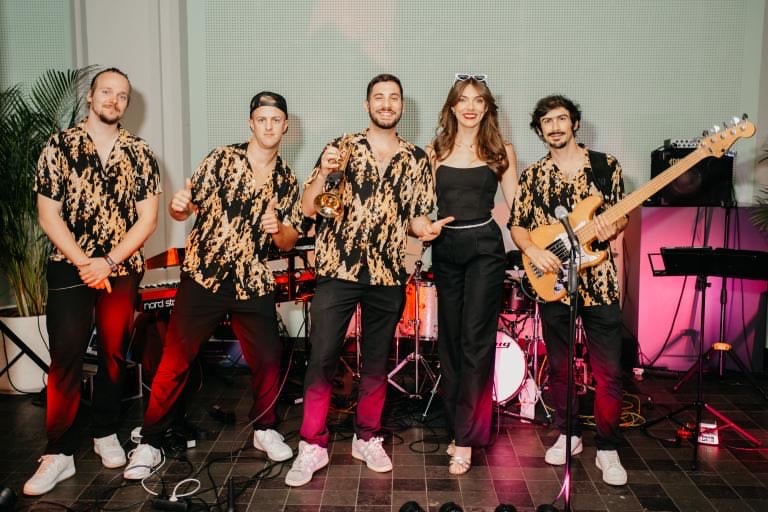
- Four-piece band and up, from €3,000, sound and light from €850 extra. Benga Band is the full party option. It needs headroom, but it runs on electronic drums and in-ears where the venue demands it.
- DJ, from €1,000, or DJ with full production from €1,850. Savoy, DJ, soul and swing into modern pop, is the easiest act to run under a hard limiter, because every level in the room sits under one fader.
The full roster is on the artists page. Lineups by event type sit under corporate entertainment in the Netherlands and wedding band Amsterdam.
What does a noise-compliant setup cost?
Nothing extra, if you choose the right lineup from the start. The cost appears when you book a full band for a room that cannot take one and then pay to solve it on the day.
Lupa's real starting prices: soloist from €600, acoustic duo from €900, jazz trio from €1,600, four-piece band from €3,000, sound and light from €850 extra, €500 per extra musician, DJ from €1,000, DJ with full production from €1,850.
For budgeting against other quotes, these are indicative market ranges for the Netherlands and Belgium; Lupa quotes every event individually. Acoustic duo €600 to €1,200. Jazz trio €1,400 to €2,400. Four-piece €1,800 to €3,200. Five to six piece €2,500 to €6,000. Seven to nine piece €5,500 to €12,000. Wedding DJ €600 to €1,500. DJ plus saxophonist €1,200 to €2,500.
Two costs people forget. An event permit with a geluidsplan often means hiring an acoustics consultant for the measurement report. And a music licence through Buma/Stemra applies to your event whether the music is live or recorded. More of these sit in our piece on the hidden costs of wedding music.
Until what time can live music play?
23:00 is the hinge in Dutch practice. Standard evening values drop to night values at that point, and in Amsterdam outdoor music events run from 11:00 until 23:00, extendable to midnight on days before a weekend or a national holiday. Indoors with a notified festivity, many municipalities allow 00:00 or 01:00.
That single fact should shape your run of show. Put the band's main set at 21:30 to 22:30 rather than 23:15, and hand the room to a DJ afterwards, because a DJ can hold a party at a controlled level in a way that eight musicians cannot. Our wedding music timeline sets this out hour by hour.
What changes when the music is outdoors?
Outdoors there is no wall helping you, so distance and direction do the work instead.
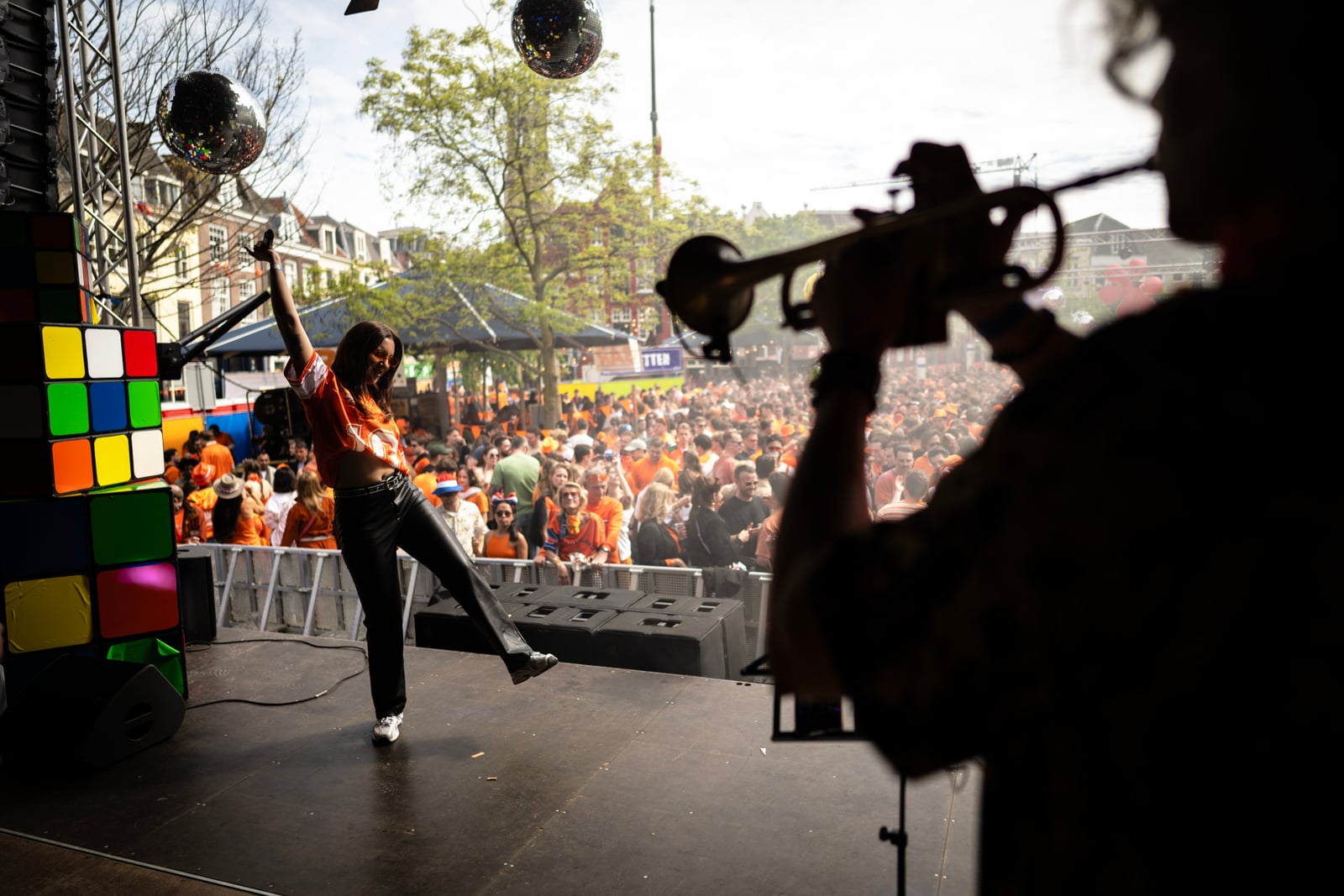
Point the PA away from the nearest homes rather than at the guests and then the homes behind them. Use more, smaller speakers close to the crowd instead of one large system throwing sound across a field. Both moves lower the level at the facade without lowering it on the dance floor.
City gardens are the hardest case, because the neighbours are 20 metres away and there is nothing to absorb the sound. We have played the Hortus Botanicus in Amsterdam, and that is exactly the profile: a beautiful outdoor room surrounded by people who live there.
Plan power at the same time. A four-piece with sound and light needs two separate 16A groups, and a generator on a private site has to be placed so that its own noise does not eat into your permitted level.
Who is responsible if the limit is broken?
The permit holder or the venue is responsible in law, not the band. In practice that means the organiser, which is you or your planner, and enforcement follows a predictable ladder: a warning, then an instruction to lower the level, then a shutdown.
The fix is boring rather than clever. Ask for the venue's limit in writing before confirming a lineup, and bring a setup built for that number. A band arguing with a limiter at 22:40 has already lost.
Frequently asked questions
What are the noise limits for live music in the Netherlands?
Indoors, standard omgevingsplan values are commonly 50 dB(A) by day, 45 dB(A) in the evening and 40 dB(A) at night, measured at the facade of the nearest home. Outdoor events are governed by the municipal permit, which in Amsterdam works mainly in dB(C).
Do I need a permit for live music at my wedding?
Not if the wedding is inside a venue that already hosts live music. You do need a permit, or at least a melding, for a garden, marquee, courtyard or any public space. Ask the venue in writing which arrangement covers your evening.
How much does it cost to hire a band that fits a noise limiter?
The same as any other booking. Lupa starts at €600 for a soloist, €900 for an acoustic duo, €1,600 for a jazz trio and €3,000 for a four-piece, sound and light from €850 extra. Choosing the right size from the start is what keeps the cost flat.
Can I book a live band for an outdoor wedding in the Netherlands?
Yes, with a permit or melding from the municipality and a lineup built for open air. Acoustic duos and jazz trios are the safest choices. A full band outdoors needs the permit, the power and the speaker placement planned together.
Until what time can live music play in the Netherlands?
Amsterdam outdoor music events run to 23:00, extendable to midnight before weekends and national holidays. Indoors, with a notified incidentele festiviteit, many municipalities allow 00:00 or 01:00. Confirm the exact end time with your venue in writing.
What is an incidentele festiviteit?
A notified evening on which a venue may exceed the standard noise values. Most APVs allow up to 12 per establishment per year, some far fewer. The venue files the notification, not the client and not the band.
What is the best act for a venue with a strict decibel limiter?
An acoustic duo, a jazz trio, or a DJ. All three keep every level under control. A full band can work too, but only with electronic drums, in-ear monitoring and no backline amplifiers on stage.
Can I hire a small acoustic act instead of a full band because of noise rules?
Yes, and it is usually the better answer. An acoustic duo from €900 or a jazz trio from €1,600 puts live musicians in rooms where a party band simply does not fit. Browse the full roster by size on our artists page.
Does a DJ have fewer noise problems than a live band?
Yes. Every source runs through one system, so the level is adjustable in seconds and no snare drum ever trips the limiter. A DJ from €1,000 is the most limiter-friendly option we book.
Do noise rules differ per municipality?
Substantially. The national transition rules give a common starting point, but each municipality sets its own event norms, end times and number of permitted festivity nights in its APV and omgevingsplan. Always check the rules for your specific gemeente.
How far in advance do I apply for an event permit?
Eight weeks is the common minimum for a straightforward event, and larger or higher-risk events need considerably longer, sometimes several months. Start as soon as the date and the site are fixed, because the geluidsplan takes time to prepare.
Who pays if the noise limit is exceeded?
The permit holder or the venue is liable, which in practice means the organiser. Bands are not the enforcement target. This is why the limit belongs in the booking conversation and not in the soundcheck.
Next step
Send us your date, your venue and one line about the noise situation, even if that line is only that you do not know yet. We reply within 12 hours with two or three act suggestions that fit the room and its limit, and we will tell you honestly if the venue you have chosen cannot hold the band you want. Request a proposal or browse the full roster.
Related reading
Planning an event?
14 hand-picked acts, bands, DJs and ensembles, ready to make your event memorable.